Delhi's Red Fort is both a seventeenth-century palace-fort and a modern landscape of museums about art, empire, resistance and independence. Visitors who focus only on the red walls miss the line of pavilions and water channel that defined the Mughal palace. Visitors who ignore the museums miss how later institutions interpret the fort's British occupation and national political memory.
A strong visit therefore moves between building and exhibition. This article explains the layers documented by the Ministry of Culture, UNESCO, the Archaeological Survey of India and government museum records. It does not promise that every named gallery is open: museum access, conservation work, closures and ticketing must be checked on current official channels.
At a glance
Start here
- Read the Red Fort first as Shah Jahan's palace-fort for Shahjahanabad.
- Use the Nahr-i-Behisht and surviving pavilions to understand the Mughal spatial layer.
- Treat the archaeological and Kranti Mandir museums as distinct interpretations, not one undifferentiated display.
- Verify the day's open museums and ticket inventory through current ASI information before arrival.
01
See a palace-fort and an archive together
The Ministry of Culture identifies the Red Fort as Shah Jahan's seventeenth-century palace-fort for the new capital of Shahjahanabad. UNESCO adds a longer historical frame: the World Heritage complex includes adjacent Salimgarh, reflects a later phase of British military occupation and became a setting for events connected with Indian independence.
The museums occupy that already layered place. Their stories about Mughal culture, 1857, Jallianwala Bagh, the Indian National Army and modern art are not detached subjects placed in a neutral hall. An editorial method is to ask at each museum why that story is being told inside this fort, and what the surrounding architecture contributes.
Sources: Ministry of Culture, Government of India; UNESCO World Heritage Centre; Press Information Bureau, Government of India02
Follow the Mughal design layer
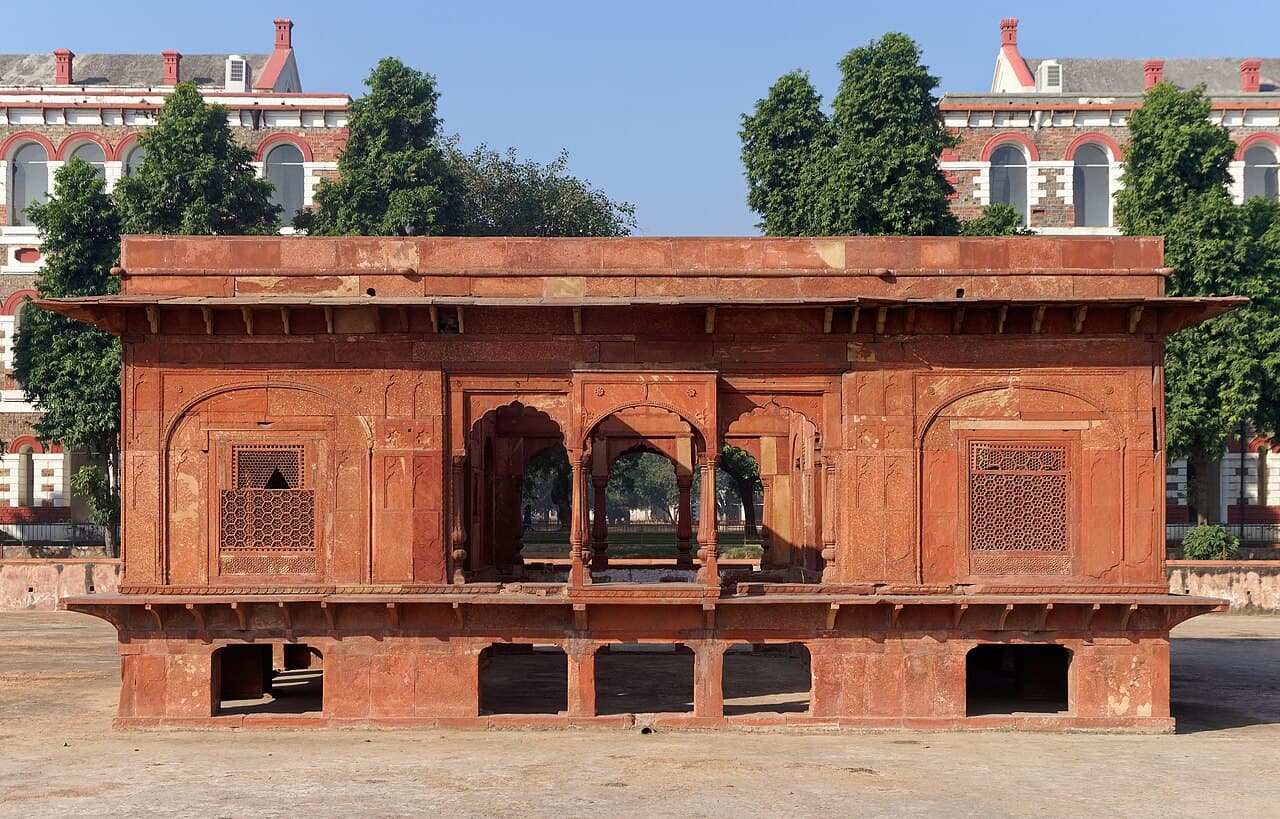
Official heritage descriptions emphasise the massive red sandstone walls, a sequence of palace pavilions and the Nahr-i-Behisht, or Stream of Paradise, that linked private apartments. The planning and decoration fused Persian, Timurid, Islamic and Indian traditions and influenced later architecture and gardens. The fort was conceived as an ordered palace environment, not only a defensive shell.
Use that structure to slow the visit. Identify the relationship among wall, ceremonial movement, pavilion and water before entering the next gallery. Do not claim that every garden or channel now appears exactly as it did under Shah Jahan; UNESCO notes later changes and questions around aspects of the current garden layout.
Sources: Ministry of Culture, Government of India; UNESCO World Heritage Centre03
Treat the archaeological museum as one account
Delhi Tourism's official page places the Red Fort Archaeological Museum in the Mumtaz Mahal and describes three galleries containing paintings, manuscripts, inscriptions, coins, sculpture and objects related to 1857, with a section on Bahadur Shah Zafar. That breadth makes it a material-culture route through several periods rather than a complete history of the fort.
The government summary may not mirror the exact gallery arrangement available on every visit. Conservation work and museum reorganisations can affect access, so confirm at the ASI ticket portal or fort entrance which museum spaces are open. When inside, read the date and provenance on individual labels instead of assuming every object came from the building in which it is displayed.
Sources: Delhi Tourism and Transportation Development Corporation; Archaeological Survey of India04
Separate the Kranti Mandir museum themes
A 2019 Ministry of Culture record lists five newer Red Fort museums: Subhas Chandra Bose and INA, Yaad-e-Jallian, the Museum on 1857, Drishyakala Museum on Indian Art, and Azaadi Ke Diwane. The subjects overlap around colonial rule and independence, but each has a different scope and interpretive problem.
Do not race through all five names as one gallery. Choose one theme before entering: military and political organisation in the INA museum, memory of the Jallianwala Bagh massacre, interpretations of 1857, art across the early modern and colonial periods, or commemoration of less familiar freedom fighters. The official record establishes the themes, not the day's opening status.
Sources: Press Information Bureau, Government of India; Press Information Bureau, Government of India05
Connect the INA museum to the fort
The government record for the Subhas Chandra Bose and Indian National Army museum describes displays on Bose's life and the INA, including artefacts, documents and photographs. It also ties the museum to the Red Fort trials of INA personnel. That connection gives the museum a site-specific reason for being inside the complex.
Keep biography, organisation, wartime context and later commemoration distinct while reading labels. A museum display is a curated interpretation, so note whose voice a quotation represents and what date an object carries. This article does not reproduce exhibit text or offer a substitute political history; it points to questions the official collection can help visitors investigate.
Sources: Press Information Bureau, Government of India; Press Information Bureau, Government of India06
Build a museum priority before arrival
A useful editorial plan gives the architecture one priority and the museums one priority. For example, trace the pavilion and water-channel idea, then choose the museum theme most relevant to your knowledge gap. Families might select a collection with objects and a narrow story rather than attempting every gallery. Returning later is better than reducing difficult histories to a sprint.
Write a two-question brief: What was this fort designed to do in Shah Jahan's capital? Why is the selected museum story located here? The Ministry of Culture and UNESCO sources support the first question; the government museum records support the second. Current signs and staff should decide the accessible route.
Sources: Ministry of Culture, Government of India; UNESCO World Heritage Centre; Press Information Bureau, Government of India; Delhi Tourism and Transportation Development Corporation07
Check ticketing and closures live
The Archaeological Survey of India's Indian Heritage portal is the official online starting point for monument ticket inventory. Use it close to the visit and look for ASI notices affecting the Red Fort. Ceremonial preparations, conservation work, security decisions or gallery maintenance can change what is accessible even when a general tourism page lists standard hours.
This article deliberately gives no fixed ticket price, opening time or closed day. Confirm whether a monument ticket includes the museum spaces you intend to see and whether a separate selection is required. If an official tourism summary conflicts with the live ASI portal or an on-site notice, use the ASI and on-site information.
Sources: Archaeological Survey of India; Delhi Tourism and Transportation Development Corporation; Ministry of Culture, Government of India08
Read every layer critically
UNESCO describes a fort shaped by Mughal design, British military occupation and events surrounding independence. The modern museums then select objects and narratives from several of those histories. No single pavilion or gallery can carry the full story, and a current exhibition label may reflect a different institutional purpose from a World Heritage statement.
End with three notes: one architectural detail, one object with a clear date and provenance, and one interpretive question that remains open. This is an editorial exercise, not a request to distrust the museum. It helps separate what the building demonstrates, what an object documents and what an exhibition argues.
Sources: UNESCO World Heritage Centre; Ministry of Culture, Government of India; Press Information Bureau, Government of India; Delhi Tourism and Transportation Development CorporationUseful answers
Reader questions
How many newer freedom and art museums were listed at Red Fort?
A 2019 Ministry of Culture release listed five in the series: Subhas Chandra Bose and INA, Yaad-e-Jallian, Museum on 1857, Drishyakala and Azaadi Ke Diwane. That record does not guarantee all five are open on your visit, so check current ASI information.
Sources: Press Information Bureau, Government of India; Archaeological Survey of IndiaWhere is the Red Fort Archaeological Museum?
Delhi Tourism's official description places it inside the Mumtaz Mahal and outlines galleries of paintings, manuscripts, inscriptions, coins, sculpture and 1857-related material. Confirm the currently accessible location and display arrangement with ASI on the day.
Sources: Delhi Tourism and Transportation Development Corporation; Archaeological Survey of IndiaWhy is there an INA museum at the Red Fort?
The official government account connects the museum's subject to the Red Fort trials of Indian National Army personnel. Its displays address Subhas Chandra Bose and INA history through artefacts, documents and photographs.
Sources: Press Information Bureau, Government of IndiaDoes one Red Fort ticket include every museum?
Do not assume that. Ticket products and gallery access can change. Check the live Archaeological Survey of India portal and the fort's current on-site notice for the exact inclusion and opening status on your date.
Sources: Archaeological Survey of IndiaRead the evidence
Sources and further reading
These sources support the relevant sections above. Plans and comparisons are editorial suggestions. Check operators for current arrangements.
- Red Fort Complex | Ministry of Culture ↗Ministry of Culture, Government of India · Accessed 14 September 2026
Seventeenth-century palace-fort, Shahjahanabad, walls, pavilions, water channel and architectural traditions.
- Red Fort Complex ↗UNESCO World Heritage Centre · Accessed 14 September 2026
World Heritage significance, Salimgarh, architectural influence, British occupation layer and independence associations.
- Dr. Mahesh Sharma Inaugurates ‘Azaadi Ke Diwane’ Museum at Red Fort Complex in Delhi ↗Press Information Bureau, Government of India · Accessed 14 September 2026
Names, themes and 2019 government description of five Red Fort museums.
- Remembering Netaji Subhas Chandra Bose - PM Inaugurates Subhas Chandra Bose Museum at Red Fort ↗Press Information Bureau, Government of India · Accessed 14 September 2026
INA museum themes, collection types and the relationship to the Red Fort trials.
- Red Fort Archaeological Museum ↗Delhi Tourism and Transportation Development Corporation · Accessed 14 September 2026
Mumtaz Mahal location and government summary of the archaeological museum's galleries and collections.
- Indian Heritage ↗Archaeological Survey of India · Accessed 14 September 2026
Current official online monument-ticketing channel used for live inventory and product confirmation.