Qutub Minar Delhi: Timings, Entry Fee, History & Photography Tips 2026
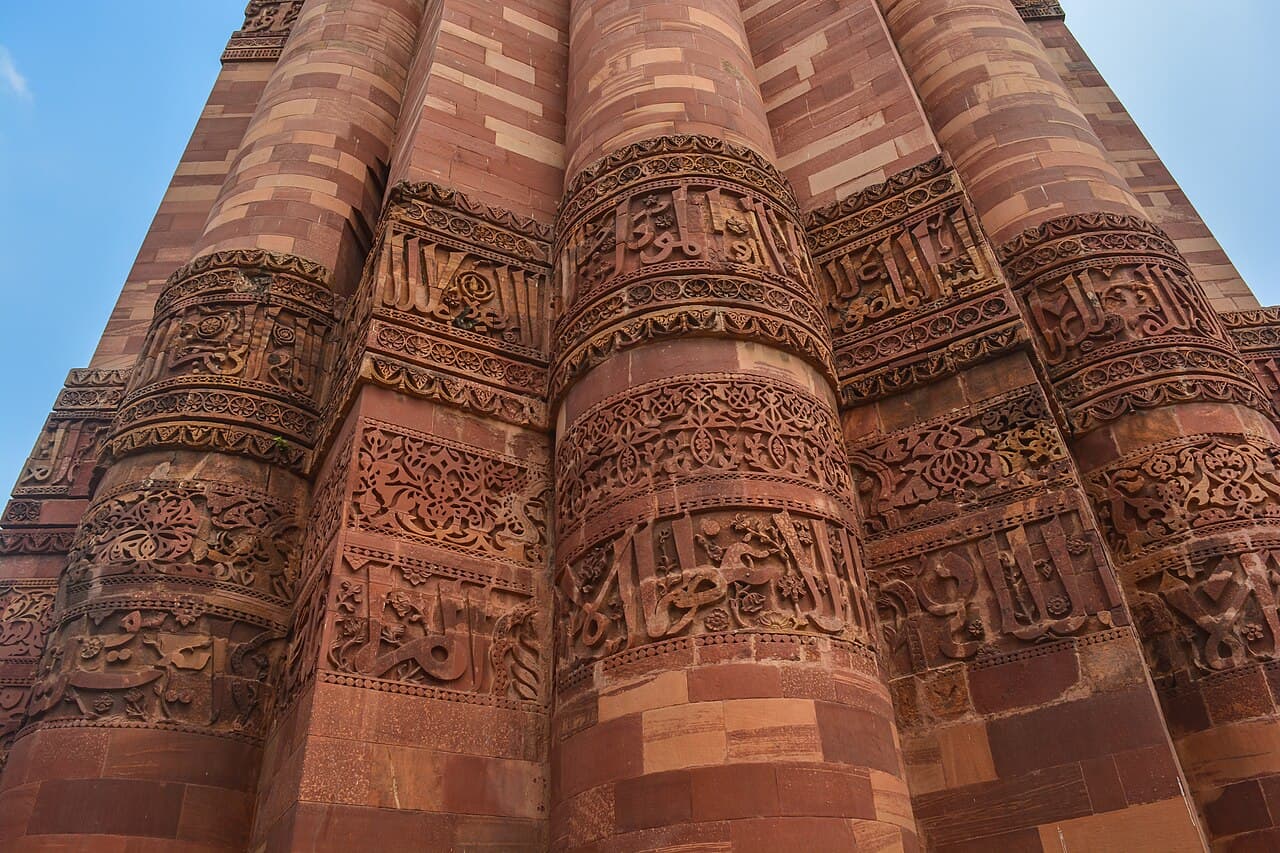
The world's tallest brick minaret, a 1,600-year-old rust-free iron pillar, and the first mosque built in Delhi — your complete 2026 guide to Qutub Minar and the UNESCO heritage complex around it.
Some monuments earn their reputation and then coast on it. Qutub Minar earns its reputation every single day. Standing 72.5 metres tall on the southern edge of Delhi — completed across five separate reigns and 193 years of construction, from 1193 to 1386 — it is the world's tallest brick minaret, a UNESCO World Heritage Site, and the anchor of a complex that contains more architectural history per square metre than almost anywhere else in India. Most people come for the photograph. The ones who stay for two hours leave understanding something about how Delhi became Delhi. Qutub ke saaye mein khade ho toh dilli ki poori umra mehsoos hoti hai.
Timings and Entry Fees
- Open: Every day, sunrise to sunset (approximately 7 AM – 5 PM in winter; 6 AM – 6 PM in summer)
- Closed: Open all year round including public holidays
- Entry fee (2026): Indians Rs 40 | Foreigners Rs 600 | Children under 15: Free
- Ticket purchase: Available at the main gate counter; also on the ASI website (asi.payumoney.com) for online booking
- Audio guide: Available at the entrance in Hindi and English for Rs 100 — worth taking if you are visiting without a guide
- Note: Entry into the Qutub Minar tower itself has been closed to the public since 1974 for safety reasons (a 1981 stampede that killed 45 people). You see the minaret from ground level and the interior of the complex — which is comprehensive enough.
The History: Five Rulers, 193 Years
The construction history of Qutub Minar is a compressed chronicle of the early Delhi Sultanate. Understanding who built what transforms the visit from "look at the tall tower" into something considerably more interesting.
- 1193 — Qutb ud-Din Aibak (founder of the Delhi Sultanate, former slave-general of Muhammad of Ghor) began construction of the minaret and the Quwwat-ul-Islam Mosque. The name Qutb Minar honours both the builder and the Sufi saint Qutbuddin Bakhtiyar Kaki, whose dargah is in Mehrauli village nearby. Aibak completed only the first storey before his death in 1210.
- 1211–1236 — Iltutmish (Aibak's successor, also a former slave) added three more stories. The transition between Aibak's first storey and Iltutmish's upper stories is visible in the masonry — a slight shift in colour and texture at approximately the 15-metre mark.
- 1316 — Alauddin Khalji initiated the unfinished Alai Minar (an attempted second, larger minaret — see below) and constructed the Alai Darwaza gateway, one of the most important architectural achievements of the Sultanate period.
- 1368 — Firuz Shah Tughluq repaired lightning damage to the top two storeys and replaced the destroyed original cupola with the current marble top. His contribution added the fifth storey to the current form.
What Is Inside the Complex
The Iron Pillar
The most physically remarkable object in the complex is not the minaret — it is the Iron Pillar standing in the courtyard of the Quwwat-ul-Islam Mosque. The pillar is approximately 7 metres tall, estimated at around 6 tonnes, and bears a Sanskrit inscription attributing it to a king named Chandra — generally identified as Chandragupta II of the Gupta Empire, dating the pillar to approximately 375–415 CE. That makes it roughly 1,600 years old.
The astonishing fact: the pillar is made of approximately 98% pure wrought iron and has not rusted in 1,600 years despite standing outdoors in the Delhi climate. Metallurgists have studied it extensively; the leading theory is that the ancient forging process (using slag inclusion and low phosphorus iron) created a passive protective layer of misawite (an iron oxide-hydroxide) that has resisted corrosion since the Gupta period. There is no comprehensive modern explanation for how fifth-century metallurgists achieved this quality.
A low railing now surrounds the pillar. The famous "arms around the pillar" tradition (believed to grant a wish if you could encircle it with arms behind your back) is no longer physically accessible — but photographs of people attempting the gesture from behind the railing are still ubiquitous. The pillar is best photographed in the morning light from the northeast, with the Quwwat-ul-Islam arches framing it.
Quwwat-ul-Islam Mosque (1193)
Quwwat-ul-Islam means "Might of Islam" — this is the first mosque built in Delhi after the Islamic conquest, constructed in 1193 by Qutb ud-Din Aibak on the site of a demolished Hindu-Jain temple complex. The construction method is historically visible and widely discussed: 27 Hindu and Jain temple columns were reused in the mosque's colonnaded screen, with their figurative carvings mostly but not completely removed. The result is a building where you can trace the seam between two civilizations in the stonework.
The arched screen facing Mecca — added by Iltutmish — uses true arches in the Persian tradition, overlaid onto a column system taken from an entirely different architectural logic. The calligraphic inscriptions on the arch spandrels are among the finest examples of Naskh script in early Indian Islamic architecture. Take your time at this screen. Photographing upward along the arches in the late morning light reveals details invisible from ground level.
Alai Darwaza (1311)
Built by Alauddin Khalji as the main entrance to the expanded mosque complex, the Alai Darwaza is one of the most significant architectural moments in the entire complex: the first true dome in Delhi built using the geometric mathematical principles of Islamic architecture, as distinct from the corbelled "false domes" of earlier Hindu-Buddhist construction. The red sandstone and white marble inlay that decorates the facade became the blueprint for Mughal architectural decoration three centuries later. The horseshoe arches, the pierced marble screens (jali), the inscriptive band in Naskh calligraphy — all of these formal elements lead in a direct line through Tughlaq and Lodi architecture to Humayun's Tomb and the Taj Mahal.
Architecture students come specifically to study this gateway. Stand inside the dome and look up — the geometry of the interior is more sophisticated than the exterior suggests.
Alai Minar (unfinished, c.1316)
Alauddin Khalji's imperial ambition produced the Alai Minar — an attempt to build a second minaret twice the height of Qutub Minar. Construction reached approximately 24 metres (the first storey) before Khalji died in 1316 and the project was abandoned. What remains is a massive, unfinished stump of rubble masonry that communicates, in its incompleteness, the extraordinary scale that was intended. The stump stands to the north of the main complex; most visitors walk past it without recognizing what it represents.
This is the most overlooked structure in the complex and the most instructive about medieval Delhi's relationship between political ambition and architectural reality.
Imam Zamin's Tomb (1539)
A smaller, later structure at the north entrance of the Alai Darwaza — the tomb of a Central Asian Muslim holy man who came to Delhi from Turkestan during the Lodi period. The sandstone and marble construction is more intimate than the surrounding monuments and represents the Lodi-period taste for smaller, ornate funerary structures. Often ignored in favour of the larger monuments; worth five minutes on a second pass through the complex.
Photography Tips
- Best time for photography: First 90 minutes after gate opening (7–8:30 AM). The morning light falls on the eastern face of the minaret, illuminating the Arabic inscriptions and geometric banding. Post-10 AM the monument is in harsh overhead light and the crowds increase substantially.
- The classic composition: Stand on the lawn approximately 50 metres south of the minaret's base, frame the full 72.5-metre height with the Quwwat-ul-Islam arches in the lower foreground. This is the photograph. It is a cliché because it is genuinely the best angle.
- Iron Pillar frame: Photograph the Iron Pillar with the Alai Darwaza arch in the background — the combination of Gupta metalwork and Khalji architecture in one frame is historically resonant and visually strong.
- Alai Darwaza detail: The marble jali (pierced screen) on the south face of the Alai Darwaza is extraordinarily detailed. Photograph it in diffused morning light (avoid direct sun which flattens the geometry).
- Avoid: Midday (11 AM – 3 PM) — harsh shadows, crowds at maximum, heat in summer months makes the experience unpleasant.
Time Required
- Casual visit: 45–60 minutes covers the main monuments.
- Proper visit: 90 minutes to 2 hours — time to read the interpretive panels, study the Iron Pillar, and walk the full complex perimeter including the Alai Minar and back structures.
- With a guide: 2–2.5 hours. The ASI-licensed guides outside the main gate are knowledgeable; agree on a price (Rs 500–800 for a full complex tour) before starting.
Getting There
- Nearest Metro: Qutub Minar (Yellow Line) — Gate 1 exit, then 700m walk or Rs 50 auto-rickshaw. The walk takes you through a pleasant tree-lined road with good pavement.
- From Central Delhi: Yellow Line from Rajiv Chowk to Qutub Minar station — approximately 25 minutes, Rs 40–50 fare.
- Parking: Paid parking lot adjacent to the complex entrance — Rs 30–50 per vehicle. Easily accessible on weekdays; arrives full quickly on weekend mornings.
Combine With: Mehrauli Archaeological Park
Directly adjacent to the Qutub Minar complex, Mehrauli Archaeological Park is free to enter and contains 100+ historically significant structures from the 10th to the 19th centuries spread across 200 acres of urban forest. Jamali Kamali Mosque (15th century, extraordinary painted interior), Balban's Tomb (c.1287, first true arch in Indian Islamic architecture), and Dargah Qutb Sahib are all within a 30-minute walk. The park is poorly signposted — hire a guide from Delhi Heritage Walks (delhiheritagewalk.com) or download the Aam Aadmi Delhi app which maps the park's key structures.
A combined Qutub Minar + Mehrauli Archaeological Park visit is among the richest historical half-days available anywhere in South Asia. Budget 4 hours total, bring water, wear good walking shoes, and go on a Tuesday or Wednesday to avoid weekend foot traffic. Ek baar yahan aaye aur poori dilli ki kahani samajh mein aaye — baki sab photoshoot hai.
Story
Culture
Reading time
7 min
Legacy editorial
First published 20 March 2026
Verify changing facts and prices independently.
More scenes from the destination
General destination planning
Check current details before you go
These official links are general planning resources, not evidence for this article. Opening hours, fares, prices, access rules and businesses can change, so confirm details independently for your dates.